All Hazards Consortium
  • Home
    • AHC Leadership
    • Vision / Mission
    • Who Is The AHC?
    • AHC Capabilities
    • What Does AHC Do?
    • Working Groups Overiew >
      • Fleet Response Working Group
    • AHC Facilitation Capabilities
    • Use Case Process / Results
    • Partnerships
  • Emergency Response
  • Reports
  • Initiatives
    • Public/Private Innovation
    • ReadyOps Service
    • Cyber
    • Mitigation Initiative
    • SISE-net Information Hub
    • STORM School
    • SISE
    • SISEnet
    • Cross-Sector Exercises
    • ORL Data Standard
    • Energy Storage Initiative
    • ENDEAVOR Model >
      • ENDEAVOR EO Alignment
  • Join Us
    • Membership
    • Sponsorship

Integrated Planning


The Integrated Planning Framework
In July of 2012, public and private sector operational leaders met in Delaware to discuss how to create a trusted environment to have frank, open and honest conversations about how to work together to get business back to business faster following major regional storms and disasters on the East Coast.

A trusted governance and planning framework was discussed, drafted and approved.

The framework would enable joint planning meetings to identify common regional operational issues and use joint tabletop exercises to test short/mid/long-term solutions.

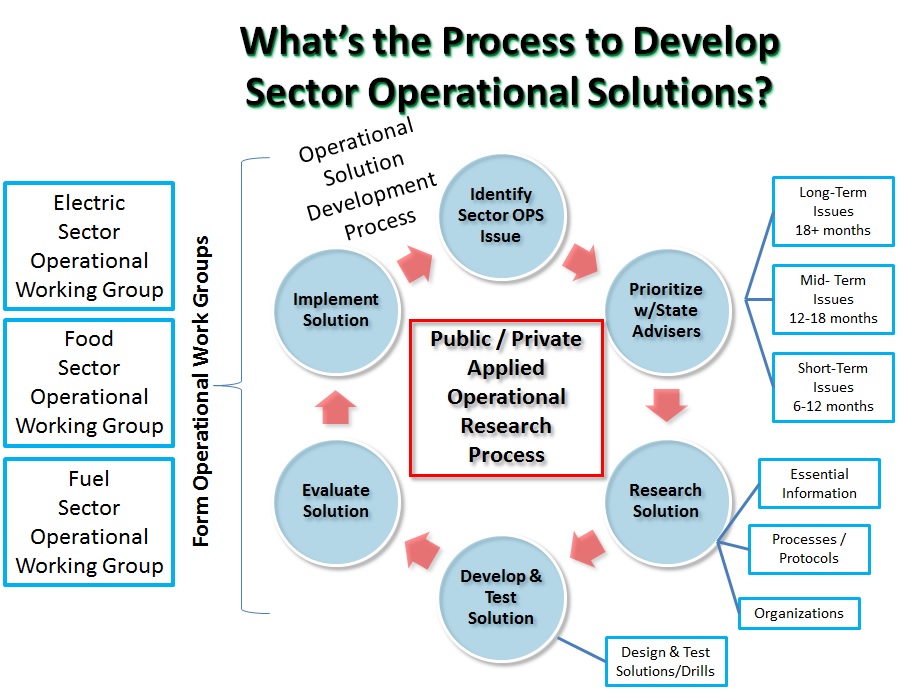
In the absence of regional public/private operational response plans, a new process had to develop to solve operational issues. The process would consist of the following steps:


  1. Organize sector-focused operational working groups
  2. Identify joint operation issues
  3. Prioritize w/state advisers
  4. Research solutions (short/mid/long-term)
  5. Develop and test solutions
  6. Evaluate (refine as needed)
  7. Implement solution
  8. Identify next issue and repeat process

Several months later, Hurricane SANDY struck the East Coast. The informal relationships already in place worked together and solved several operational issues, and the framework was formalized into a regional planning and governance structure.

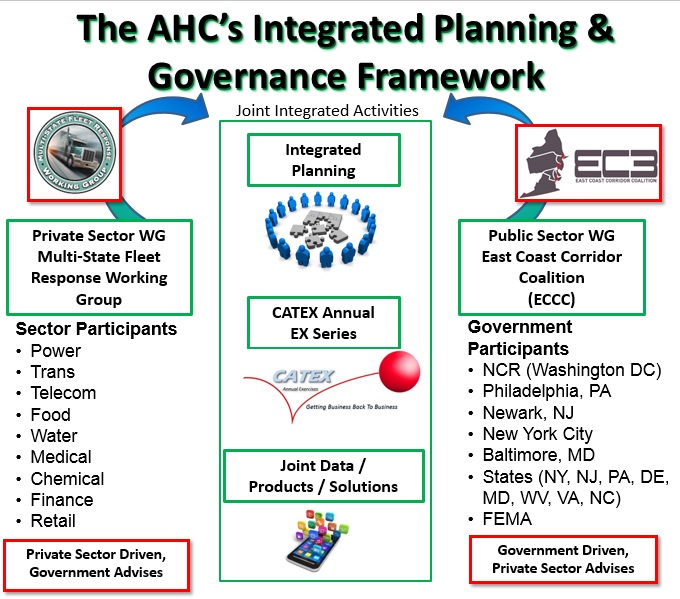
The Regional Integrated Planning & Governance Framework was created to provide a legal and operational public/private planning architecture designed to resolve operational issues facing multiple states and regulated utilities in the electric, food and fuel sectors during disasters.

The framework currently supports two regional working groups and an annual regional “corridor” exercise focused on expediting power restoration


  • The public sector’s EC3 (East Coast Corridor Coalition) work group comprised of operations professionals in public sector
  • The private sector’s Multi-State Fleet Response work group comprised of operations professionals in private sector “lifeline” sectors (electric, food, fuel, etc.)

This planning framework has produced a number of solutions that have been operational since 2014, and have expanded to other regions and sectors.


Picture
Picture
2026 All Hazards Consortium. All Rights Reserved. Privacy Statement
  • Home
    • AHC Leadership
    • Vision / Mission
    • Who Is The AHC?
    • AHC Capabilities
    • What Does AHC Do?
    • Working Groups Overiew >
      • Fleet Response Working Group
    • AHC Facilitation Capabilities
    • Use Case Process / Results
    • Partnerships
  • Emergency Response
  • Reports
  • Initiatives
    • Public/Private Innovation
    • ReadyOps Service
    • Cyber
    • Mitigation Initiative
    • SISE-net Information Hub
    • STORM School
    • SISE
    • SISEnet
    • Cross-Sector Exercises
    • ORL Data Standard
    • Energy Storage Initiative
    • ENDEAVOR Model >
      • ENDEAVOR EO Alignment
  • Join Us
    • Membership
    • Sponsorship